The Goddess Test by Aimee Carter AND Starcrossed by Josephine Angelini


Double Feature is an occasional feature where I discuss/review two books, often comparing and contrasting characters or elements that were similar or different.  I try my best to not include spoilers, or to give a spoiler warning before them, but because these reviews are more in-depth than regular reviews, it is possible there might be some plot points given away.  Read at your own risk.

The Goddess Test by Aimee Carter
Publisher: Harlequin Teen
Publication date: April 2011
ISBN: 9780373210268
Source: Library


Starcrossed by Josephine Angelini
Publisher: HarperTeen
Publication date: May 2011
ISBN: 9780062011992
Source: Review copy provided by publisher (and NetGalley)


The Goddess Test (Harlequin Teen) Starcrossed

Summary of The Goddess Test (GT)
For all her life, Kate has been with just her mom, and now her mom is dying of cancer.  Her last request is to die in the small town she grew up in.  Her new life is only complicated more when she meets Henry, who claims to be Hades.  But, when he brings a girl back from the dead, she begins to wonder if he's telling the truth.  And if he is, could he save her mother too?  Kate will find out when she faces trials and tests that every other girl who's tried before has failed.  Will she succeed and save her mother's life?

Summary of Starcrossed (SC)
Helen has spent all her life trying to hide from notice.  That becomes increasingly difficult as she gets taller and more gorgeous.  Oh, and when she realizes she has unusual powers as well.  All that changes when the Delos family moves to Nantucket and she feels overwhelming feelings toward them, especially Lucas.  Feelings she might not be able to control.  As she learns more about them and the mysterious dreams she's been having, she gets caught in a centuries old battle that could take her life and the lives of everyone she cares about.

The Mythology:
GT: This one was actually pretty light on mythology, despite having more of a presence from gods.  It didn't seem to include too many details and too much history at once.  Yes, Kate had to spend lots of time learning the myths, but fortunately we didn't.  I both liked and disliked that, because I wasn't overwhelmed with info, but still would have enjoyed a little more.

SC: A lot more mythology made it into this book.  It was very clear that Angelini has a thorough knowledge of Greek mythology.  I really liked the way she described the Houses and the Furies and all the history that goes along with it.  At times, however, it was a little too much and got a bit dull.  Still, the mythology had more involvement in the story and the characters than GT did.  I liked how it took a different path than most mythology books now - less about the gods involvement and more about the heroes.

The Romance:
GT: It was really sweet, actually.  I was glad that it avoided the deadly trap of insta-love and instead developed over the time Henry and Kate spent together.  It felt a little like Beauty and the Beast in that things went much more slowly.  While I often didn't like Henry for some of the things he did, I thought he was a pretty nice guy and not the typical "bad boy" that you'd expect from a Hades character.  Surprisingly refreshing.

SC: I was not terribly impressed with the romance in this one.  While I saw some of the appeal of Lucas, I was annoyed with him for the most part.  He really did jerk Helen around a lot and he had a little too much of a stalker-y feel sometimes for my preferences.  I liked the way Helen and Lucas interacted and the fun they did have, when they weren't fighting or trying to kill one another though.  
_____________________________
Things I Liked about GT:
I thought the story was really interesting.  I liked the different take on the Persephone myth, which wasn't precisely a repeat of history, but more of a continuation.  It was unique in that respect.  Also, while I was confused and wish I knew more for a lot of the book, I did find the ending to be surprising and yet satisfying.  It was a solid book that offered more than I expected and had a sweet romance to top it off.


Things I Liked about SC:
I quite enjoyed the way this one developed.  It was very complicated and interesting and took several turns I didn't expect.  I liked the minor supporting characters, particularly Claire and some of the Delos family.  They felt like people I would want to be friends with.  It was fun to have Helen learn about her powers and how she tried to get control of them.  Plenty of double crossing and mysterious motives made the ending very good too.  An all around solid debut. 
_____________________________
Things I Didn't Like about GT:
I was a bit annoyed sometimes when they talked about people who were already dead being killed again.  I thought that was a little too unbelievable and made it hard to accept some of the story.  Yes, eventually it made sense, but I still thought it was weird and it drew me out of the story.  The writing is also not the best I've read, but has a lot of potential.  I'm impressed enough to read the next book and was really glad this one didn't end on a cliffhanger that made me need it NOW.


Things I Didn't Like about SC:
I think perhaps it felt a little too much like a first book, with some overdone phrases and too many pages of description.  I think it might have been a bit more solid if some of the info had been cut.  The story felt very similar to Twilight too - girl meets mysterious boy who wants to kill her, has a big "special" family that wants to stalk/protect her, etc, etc.  Some of this was good (I liked the Delos family) and some of it annoyed me (the waffling, sometimes creepy love interest).  But, I'm interested enough to want to read the next book to see what happens. 

Read-alikes:
Percy Jackson and Heroes of Olympus series by Rick Riordan

Also a little like Goddess of Yesterday by Carolyn Cooney

BOOK CONTENT RATINGS for GT:
s-factor: !@
here and there


mrg-factor: X
some implied stuff left to the imagination mostly


v-factor: ->
a couple of incidents, not too graphic


Overall rating: **** 

_____________________________ 

BOOK CONTENT RATINGS for SC:
s-factor: !@
regularly throughout, but nothing too strong


mrg-factor: X
some talk, but nothing on page


v-factor: ->->
quite a bit of action fighting


Overall rating: ****

I'm really have a hard time picking one I liked more than the other. Anyone else read both?

If you buy through my Amazon linkage, I will get a very small percentage

Harry Potter and the Order of the Phoenix AND Harry Potter and the Half-Blood Prince by J.K. Rowling


Double Feature is an occasional feature where I discuss/review two books, often comparing and contrasting characters or elements that were similar or different.  I try my best to not include spoilers, or to give a spoiler warning before them, but because these reviews are more in-depth than regular reviews, it is possible there might be some plot points given away.  Read at your own risk.

Harry Potter and the Order of the Phoenix by J.K. Rowling
Publisher: Scholastic
Publication date: June 2003
ISBN: 9780439358071
Source: Library (audiobook)


Harry Potter and the Half-Blood Prince by J.K. Rowling
Publisher: Scholastic
Publication date: July 2005
ISBN: 9780439785969
Source: Library (audiobook)


Harry Potter And The Order Of The Phoenix Harry Potter and the Half-Blood Prince (Book 6)

I'm pretty sure these don't need summaries, so I'm not giving them ones :)

Things I Liked about HP5:
This is one where things begin to be very dark.  The Order plays a huge part in the book and the kids are so frustrated at not being invited into it, despite all they have accomplished.  It is also a pretty complex book with a lot of different things going on at once (Rowling is a master of the multiple plot lines).  I also remember when I first read it and I just hated what happened at the end - it was so sad.  There didn't seem to be much closure for Sirius' death (I really hope that didn't spoil someone).  I honestly thought he wasn't really dead.  What is that veil thing anyway?


Things I Didn't Like about HP5:
I really didn't like Harry.  Oh, the whining and the getting angry and the yelling were so annoying.  Listening to it on audio brought forward just how often he was mad and using that grumpy voice.  He has a real anger management issue in this one.  I think he does better at managing it in the next book, but he was annoying.  Also, the whole problem between Harry and Dumbledore seemed like a contrivance to help out the plot.  And it was really stupid on Dumbledore's part.


Things I Liked about HP6:
Being the penultimate book in the series, I think this must have been one of the hardest to write.  I remember learning tons of stuff about Horcruxes but still not really getting it.  I loved Harry's relationship with Dumbledore and how they seemed to finally work out their issues.  There is so much backstory that we finally learn too, but not enough.  Rowling saves most of the meat of it for the last book, of course.  Definitely the one that was the hardest after I read it to wait for the next book.  I love the character Slughorn, who is at once slimy and kind of a jerk and also not a bad guy, per se.  And, of course, I totally never saw the Half-Blood Prince coming.  A great surprise.  (Which, again, Rowling is a master of surprises.)

Things I Didn't Like about HP6: 
Don't remember much I didn't like about it, except for the big death scene.  It was pretty horrifying.  And I don't know how she managed to set it up so it was still possible to wonder about Snape being good or bad.  Really, her storytelling abilities are fantastic.

Read-alikes:
Not like it, but some similar stuff:

Artemis Fowl by Eoin Colfer
Ranger's Apprentice by John Flanagan
Percy Jackson and the Olympians by Rick Riordan

BOOK CONTENT RATINGS for Both:
s-factor: !@
some, not tons


mrg-factor: X
enough snogging already :)


v-factor: ->->->
lots of action and fighting and scary stuff


Overall rating: *****

Sometimes I wish I could read these books again for the first time and experience all the surprises and excitement of learning what will happen next.

If you buy through my Amazon linkage, I will get a very small percentage

Dragonbreath and Dragonbreath: Attack of the Ninja Frogs by Ursula Vernon


Double Feature is an occasional feature where I discuss/review two books, often comparing and contrasting characters or elements that were similar or different.  I try my best to not include spoilers, or to give a spoiler warning before them, but because these reviews are more in-depth than regular reviews, it is possible there might be some plot points given away.  Read at your own risk.

Dragonbreath by Ursula Vernon
Publisher: Dial
Publication date: June 2009
ISBN: 9780803733633
Source: Library 


Dragonbreath: Attack of the Ninja Frogs by Ursula Vernon
Publisher: Dial
Publication date: February 2010
ISBN: 9780803733657
Source: Library


DragonbreathDragonbreath: Attack of the Ninja Frogs 

Summary book 1:
Danny Dragonbreath definitely is not your typical student at the amphibian/reptile school he attends.  Being the only mythical creature there, it is especially hard to not be able to breathe fire and prove he is a dragon.  But, when he doesn't do so well on his report of the ocean, he can call on his cousin the sea serpent to help him out.  Actually seeing and touching underwater creatures, especially the giant squid, is much more thrilling than simply reading about them.

Summary book 2:
In Danny and Wendell's next adventure, the foreign exchange student Suki is being stalked by ninja frogs.  The boys must visit Japan in order to find out just why those ninja frogs are after her.  Can Danny find his fire breathing abilities in time to save them from the deadly frogs?

Things I Liked about both:
The books are short and so, so funny. They have this quirky cast of reptiles, amphibians and, of course, Danny the dragon.  He and his best pal Wendell the iguana sound very much like typical tween boys, avoiding homework and bullies left and right, having first time crushes on cute girls.  It is full of tween humor and absolute silliness, plus the mix of comic strips, illustrations, and text make these books an easy choice for reluctant readers. Here are some of my favorite funny parts from both:

Danny hated standing still for anything.  It was just dragonish nature.  Dragons slept on their hoards, they fought knights, they occasionally flew around terrorizing peasants, but they didn't usually stand still.  (It's worth noting that Danny's parents had never terrorized a peasant in their lives, and Danny's mother always volunteered to bring goodies to the school bake sale, but really, it was the principle of the thing.) p 16-17, book 1
A ferocious predator, what the common potato salad lacks in bone structure, it more than makes up for in viciousness.  A school of potato salad can skeletonize a cow in under two weeks, assuming that the cow doesn't get bored and move. p 30, book 1
He was feeling rather disillusioned by the whole adventure.  Ninjas were apparently jerks, and Suki didn't want to be a ninja queen.  Plus, there was no super-secret kung fu technique for breathing fire, and the grand quest to find the enemies of the Spurtongue Clan involved a fifteen-minute walk and a mailbox.  If they made a king fu movie out of this adventure, it would probably be called Savage Fist of Boredom. p 106-107, book 2
Things I Didn't Like about both: 
They are very light on plot.  There isn't much purpose to the books, except to tell a funny story with maybe a little learning about the ocean or about Japanese culture on the side.  Simple, quick, and entertaining, but not much else.
 
Read-alikes:
Adventures of Ook and Gluk and other Dav Pilkey books


BOOK CONTENT RATINGS for both:
s-factor: none

mrg-factor: none

v-factor: none

Overall rating: ****

Posted as part of Tween Tuesday, hosted by GreenBeanTeenQueen.

If you buy through my Amazon linkage, I will get a very small percentage

Uglies by Scott Westerfeld and Delirium by Lauren Oliver


Double Feature is an occasional feature where I discuss/review two books, often comparing and contrasting characters or elements that were similar or different.  I try my best to not include spoilers, or to give a spoiler warning before them, but because these reviews are more in-depth than regular reviews, it is possible there might be some plot points given away.  Read at your own risk.

Uglies by Scott Westerfeld

Publisher: Simon Pulse
Publication date: 2005
ISBN: 9780689865381

Source: Library (book group)

Delirium by Lauren Oliver
Publisher: HarperCollins
Publication date: February 2011
ISBN: 9780061726828
Source: ARC provided by Traveling ARC Tours and e-copy through NetGalley


Uglies (Uglies Trilogy, Book 1)Delirium (Delirium - Trilogy) 

Summaries:
Uglies: Tally is just counting the days until she turns sixteen and can turn pretty.  In a world where everyone is gorgeous and happy, she is ready for her turn.  When she meets a new friend Shay, who talks about being pretty as if it isn't the most important thing, she thinks it's a joke.  Until Shay runs away and leaves the world of pretties behind.  Tally is then faced with a desperate choice between friendship and being pretty.

Delirium: Lena can't wait until she's gotten the cure.  In a world where amor deliria nervosa (ie love) is a disease, Lena wants the security and stability that will come from having calm if cold relationships.  After all, love is dangerous and will eventually kill you.  But, life has other plans for her.  Into her rigid and structured life comes a boy and Lena does the unthinkable.  She falls in love.

Similarities: 
Apart from the obvious, that they are dystopian books, these books had some other things in common.  The thing I first noticed was that there is a "cure" of sorts.  In Delirium (hereafter D), it is a cure for delirium nervosa, while in Uglies (hereafter U) it is a cure or procedure to get rid of ugliness.  The cure is what the entire novel revolves around in both.  

Also, in both books, the main character begins by believing wholeheartedly in the cure.  They are looking forward to the day when they will receive it and they are even both counting down the days until it happens.  It is also a close girl friend who first puts into our characters' minds the idea that it may not be what they think it is.  Hana in D is Lena's best friend and she appears not to be like most people - not afraid to speak out against the cure and the government that institutes it.  In U, Shay is the one who first gets Tally thinking about what being pretty might mean.  Shay and Hana also both encourage Tally and Lena to do things that are illegal like sneaking out and visiting forbidden places.  

A third similarity is in the male love interest.  For Lena in D, she meets Alex, who she at first believes is cured and therefore safe.  As time goes on (*spoiler*) she learns he is an uncured like her and also from outside of her town, the place where traitors and invalids live. (*end spoiler*)  Similarly, Tally in U meets David, who is unmistakably still an ugly, but who lives outside of the government's sway in a place where traitors and those who aren't cured live.  These boys open the eyes of both Lena and Tally to seeing that there is so much more to life that what they think and what the government tells them it should be.  Also, the main character visits these outside places at least once during the story.

Differences:
There are, of course, things that are very different about these two books.  One big difference is the presence of the government.  While it is obvious that both control everyday life, in U it was much more proactive in destroying those who don't obey the rules.  They actively seek out the Smoke and try to eradicate them.  In D, they keep outsiders away from those in the cities largely by fear and lining the borders with fences and electricity.  They were not interested in going outside of their cities and finding people after they initially thought they got rid of them all.  

The cures are also different, of course.  In U, it is obvious at first glance when someone hasn't had the cure - they are still ugly.  Also, (*spoiler*) there is more to the cure than just getting rid of ugliness, a part of the brain that is changed so people don't think much. (*end spoiler*)   In D, you can only tell if a person is cured by a small scar on their heads - a scar which could be faked.  Everyone knows that the cure for delirium nervosa affects how people feel and seems to dull all of their sensibilities.  There was no government effort to hide side effects or things of that sort.  Also, it was not really optional to receive the treatment in D, whereas there are a few people mentioned in U that choose to remain ugly.  There are no severe consequences mentioned in relation to those who choose that, except they aren't welcome in the pretty societies.  

Things also are different in relation to Hana and Shay later on.  While Shay is still very much opposed to the cure and escapes from that life into the Smoke, Hana's rebellion will not lead her to give up her current life.  She plans to stay in the city and receive her cure.

Things I Liked in Uglies:
This was my second time reading Uglies, for our book group.  We had a lot of lively discussion of this title, and everyone seemed to enjoy the book.  We all loved the society and the impact it made on our own views of what's beautiful.  I loved having a chance to reread it and get a more in-depth look at what Westerfeld might have been saying.  Most of us, on first reading, just get sucked into the fast-paced story and what will happen next.  This time around, I was struck by the comparisons Westerfeld and even the main characters made between the operation and growing up.  They often talk about "growing up" and thinking about what they want to look like, but the main part of the story is when Tally grows up in completely different ways.  She finds a little bit of herself at a time to love, even while she's ugly.  A lot to discuss and also a lot of fun.  Still one of my favorite dystopian books.


Things I Liked in Delirium:
This is a book that will make you think long and hard about almost everything in your life.  But, especially your relationships.  It will force you to look at them and remember why you love those people and what you would do for them.  It questions why we love and how we love and what we want from life.  At the risk of repeating that word too many times, I loved it.  Not only does Lena deal with falling in love with someone, but her relationships with her best friend, a young cousin, and her mother, are all woven into the plot.  Oliver's writing is beautiful; I don't know how many passages I marked in the book, but it felt like every page had something I wanted to share.  She has a talent for evoking feeling in every sentence and metaphors that feel so real and vivid, it's impossible to see things in any other way.  I was particularly intrigued by the dystopian world that was created.  It was very well developed and I especially enjoyed the quotes at the beginning of each chapter from a book that managed to change a lot of familiar stories.  It was awesome.  I'm going to be thinking about this one for a long time to come.  I think that is a sign of a great book.  I think these quotes also catch the essence of this book really well, both the writing and the content.  If you aren't at least intrigued, I'll be surprised.

It's only slightly better than the other word that followed me for years after my mom's death, a snakelike hiss, undulating, leaving its trail of poison: Suicide.  A sideways word, a word that people whisper and mutter and cough: a word that must be squeezed out behind cupped palms or murmured behind closed doors.  p 10-11 of ARC
Most of us won't see each other after graduation, and even if we do it will be different.  We'll be different.  We'll be adults, cured, tagged and labeled and paired and identified and placed neatly on our life path, perfectly round marbles set to roll down even, well-defined slopes. p 90 of ARC
I said that without love, there could also be no hate: without hate, no violence.  Hate isn't the most dangerous thing, he'd said.  Indifference is. p 362 of ARC
It occurs to me that this numbness, this feeling of separation, must be what she and every cured experiences all the time: as though there is a thick, muffling pane of glass between you and everybody else.  Hardly anything penetrates.  Hardly anything matters.  They say the cure is about happiness, but I understand now that it isn't, and it never was.  It's about fear: fear of pain, fear of hurt, fear, fear, fear - a blind animal existence, bumping between walls, shuffling between ever-narrowing hallways, terrified and dull and stupid. p 383 of ARC
Things I Didn't Like in Uglies:
The beginning does move a bit slow, before Shay takes off.  Otherwise, I really just loved reading it again.  


Things I Didn't Like in Delirium:
I was kind of a little surprised that she went with the ending she did.  While I expected something of the sort, I was rather hoping for something a little different.  Mind you, it was a seriously twisty ending and I nearly dropped the book when I read it, but it just wasn't what I thought it would be.  Which, actually now that I think about it, is more of a strength of the book and something I like than something I don't like. :)  Maybe it's because I want more books about this world and I can't tell if there will be from the ending.  I hope so.  The only other problem I had was the beginning being a little slow in places.  Oh, and the slightly unbelievable premise that people wanted to eradicate love.  But, these are minor squibbles.  Read it!


Read-alikes:
Unwind by Neal Shusterman

Matched by Ally Condie
The Maze Runner by James Dashner

The Giver by Lois Lowry

BOOK CONTENT RATINGS for Uglies:
s-factor: !
maybe a few


mrg-factor: none

v-factor: ->->
some action sequences and scary parts


Overall rating: *****

_______________________________________
BOOK CONTENT RATINGS for Delirium:
s-factor: !@#
very few in number, but some f-words


mrg-factor: X
some moments, but it was really quite tame


v-factor: ->->->
there are some rather violent scenes


Overall rating: *****

What do you think? Have you read them both?

Posted as part of Presenting Lenore's Dystopian February celebration. Check it out!


If you buy through my Amazon linkage, I will get a very small percentage

Clockwork Angel by Cassandra Clare AND Hush, Hush by Becca Fitzpatrick

While these two books might not appear to be similar enough for this kind of comparison, I was reading them at about the same time and was struck by a few similarities and things I wanted to discuss in relation to each other.  So, I present to you another double feature.

Clockwork Angel by Cassandra Clare
Publisher: Simon & Schuster (Margaret K. McElderry)
Publication date: August 2010
ISBN: 9781416975861

Source: ARC provided by Traveling ARC Tours

Hush, Hush by Becca Fitzpatrick
Publisher: Simon & Schuster Children's Publishing
Publication date: October 2009
ISBN: 9781416989424
Source: Purchased

Clockwork Angel (The Infernal Devices, Book 1)  Hush, Hush

Summaries:

Clockwork Angel: Tessa Gray does not expect what awaits her when she arrives in England, searching for her brother.  After being kidnapped by the Dark Sisters and discovering a world full of dark creatures - vampires, werewolves, warlocks - she finds herself as one of them, a creature not human with a unique power.  She manages to escape for a time and hides with the Shadowhunters, those who are supposed to protect humans (mundanes) from downworlder creatures.  But, she finds herself drawn to two best friends, Will and Jem, both different and yet appealing to her in different ways.  But, being caught up in this world means she might have to make a choice between saving her brother or saving the world.

Hush, Hush: Nora Gray is just an average girl, trying to recover from the unexpected death of her father.  When her new biology partner, Patch, is thrown into her life, she feels equally drawn to his dark nature and repelled by his sinister secrets.  But, when she learns the truth about him, she is sucked into a deadly game where she is the target.

Nephilim and/or Angel Mythology: 

CA: In this book, the Nephilim are the good guys (even if they're pretty arrogant), set to protect humans/mundanes from demons and other downworlders.  They are not necessarily descended from "fallen" angels, but from a mixture of one angel's blood with human blood, creating somewhat immortal beings that call themselves Shadowhunters.  This also inevitably includes mixtures of the demon race with humans, who are downworlders like werewolves, warlocks, and vampires.  Tessa is introduced to Shadowhunters rather abruptly - a bit like throwing the whole bucket of cold water on her at once - and right near the beginning of the book.  However, she already has had some glimpses of unnatural beings because her own abilities.  I prefer this kind of introduction, since the slower ones are usually so long in coming they get ridiculous.

HH: In this book, Nephilim are not the good guys.  Fallen angels and the Nephilim are separate things in this book.  And the Nephilim are not all descended from just one angel.  They are the race created when a human and a fallen angel have children.  Fallen angels apparently don't experience human things completely.  However, they can possess bodies of humans so that they can experience things more fully.  Things are less well explained in this book, I think, leaving a lot of questions and confusion.  There is not really any talk of demons as separate from fallen angels, so I get the impression that they are the same thing in this book.  Nora gets a very slow introduction to them.  She mostly just thinks she's going nuts, rather than that Patch might have a big secret that means he's not human.  Nothing like a slow-revealing mystery that was pretty obvious to everyone from the front cover of the book, but which Nora must figure out one painful step at a time.  And, of course, through the internet.

The Ladies:

CA: I like Tessa - she's timid and definitely not what you'd immediately think of as a tough heroine.  She's a regular woman in the 1800s who still pretty much believes in a place for women and that she should not step out of it, which is refreshing to me.   A lot of historical characters in books have very modern views, but I think she balances that quite well.  She's a likeable character who is true to her time and not totally modern, but also not really a wimp either.  She isn't into fighting and everything, but she's got a brain and will use it if needed.

HH: Nora is back and forth for me - she says things that are smart and that would indicate intelligence, yet she also ignores warning and feelings and keeps being drawn to dark, dangerous, and rebellious Patch.  Apparently she thinks, but does not really act on those thoughts.  I do have to admit she's stupid when it comes to liking a guy she's not entirely sure is safe, not to mention wants to possibly kill her.  She's a very conflicted person, obviously.  One minute she likes and trusts him, the next she doesn't.

The Gents: 

CA: I like both Jem and Will, though they both obviously are flawed and have problems.  Deep down, I think they are both good, but there are some things that make them just a little bit frightening as a love interest.  However, both feel quite real, their characters' are described in such a way that they are brought to life.  They have both good and bad sides, just like all of us.  I'm not sure which one I like more, since they are both so different.  Hopefully the next book will help me decide.

HH: I hate Patch.  Really, I do.  I've never been drawn to bad guys, so maybe that's it, but he's got some serious issues that I'd never be able to overlook.  I'm sure there are guys out there like him, which I would stay far, far away from.  He seems really back and forth too, which probably exacerbates Nora's wishy washy ways.  He's a little bit good, a lot bad, a jerk, a nice guy, etc.  Make up your mind already. 

Things I Liked in CA:
It has some positively lovely writing - her descriptions are so beautiful and vivid that each person and each setting seems so real.  The story was surprising - taking turns, albeit mostly near the end, that I did not expect.  I really enjoyed how things developed and that clues were dropped throughout, but not enough for me to figure it all out before.  I was pretty much caught completely off guard for a few of them.  In an overcrowded market of paranormal, this one shines as original and delightful.  I'm definitely looking forward to more in this series.  Some favorite parts:

Now that she had worn other faces, seen through other eyes, how could she ever say any face was really her own, even if it was the face she [had] been given at birth?  When she Changed back to herself, how was she to know there wasn't some slight shift in her very self, something that made her not who she was anymore?  Or did it matter what she looked like at all?  Was her face nothing but a mast of flesh, irrelevant to her true self?  p 110 of ARC
"I've known girls who were quite companionable with their ladies' maids," Tessa protested.  This was not precisely true.  She had read about such girls, though she had never known one.  Still, according to novels, the main function of a ladies' maid was to listen to you as you poured your heart out about your tragic love life, and occasionally to dress in your clothes and pretend to be you so you could avoid being captured by a villain.  p 132 of ARC
The woman who sat in the tallest of the chairs was slender and stately.  A hat was tipped forward on her head, balancing a massive black plume at its top.  Her dress was of rich red velvet, her icy white skin swelling gently over the fitted bodice, though her chest never rose or fell with a breath.  A rope of rubies wound her throat like a scar.  Her hair was thick and pale blond, clustered in delicate icy curls around her nape; her eyes were a luminous green that shone like a cat's. p 176 of ARC
"I," said Gabriel, "would rather have my entrails yanked out and tied in a knot in front of my own eyes than apologize to such a worm."
"Gracious," said Jem mildly.  "You can't mean that.  Not the Will being a worm part, of course.  The bit about the entrails.  That sounds dreadful."
"I do mean it," said Gabriel, warming to his subject.  "I would rather be dropped into a vat of Malphas venom and left to dissolve slowly until only my bones were left."
"Really," said Will.  "Because I happen to know a chap who could sell us a vat of- " p 207 of ARC
Things I Liked in HH:
I will admit that the creepy atmosphere and the setting of the book were quite well done.  You feel a sense on unease throughout that makes you wonder both what is coming and when it will come.  The ending is surprising as well, not exactly what you expect.  I like how there are some loose ends in the story that will be addressed in the next books.  I thought it had some intriguing twists and turns, not to mention it has that weird element of you-must-keep-reading-me.  It must be the action and suspense and the good creepy atmosphere.  And it has a lot of teen appeal and did much to create interest in reading, rather like Twilight.  I'm glad there are books that will do this still.

Things I Didn't Like in CA:
It seemed a bit slow at the start.  The action, while pretty much throughout, wasn't quite as exciting as it became at the end.  


Things I Didn't Like in HH:
I admit to being completely annoyed with Nora for being such an idiot (I am not entirely sure you got that vibe from my previous comments on the book).  She is so utterly stupid that it makes you wonder how she will survive.  I will agree that some amount of appeal in a dangerous guy exists and that your heart will lead you where it will, but she seems to be brainless.  He treats her like crap sometimes, and she just keeps coming back for more.  Her mother is so blind that she unwittingly leaves her teenage daughter alone for days at a time.  What, kids that age don't need adult supervision?  I thought the ending, while clever, suffered from not enough information and explanation.  An interesting twist that could have been better if there was more information about fallen angels, Nephilim, and Nora's part in it all.  And, of course, it suffers from comparisons to Twilight, to which it has some very strong similarities.  I hope for more from the sequels.

Read-alikes:
Mortal Instruments series by Cassandra Clare

Gemma Doyle trilogy by Libba Bray
Twilight by Stephenie Meyer
Need and Captivate by Carrie Jones

BOOK CONTENT RATINGS for CA:
s-factor: !
a few


mrg-factor: none
just some nice kissing :)


v-factor: ->-> 
rather a lot of fighting, as expected


Overall rating: *****
______________________________________________________________

BOOK CONTENT RATINGS for HH:
s-factor: !@

some here and there

mrg-factor: XXX
full of innuendo and sensuality, though not much actual action


v-factor: ->->
mostly its frightening stuff, rather than violent


Overall rating: ***


Do you have a favorite fallen angel/nephilim book?

If you buy through my Amazon linkage, I will get a very small percentage

Harry Potter and the Prisoner of Azkaban AND Harry Potter and the Goblet of Fire by J.K. Rowling


Second double feature (well, I guess technically third, since I reviewed the first two HP books together).  Also, my second review for GalleySmith's Harry Potter Reading Challenge, and joint review with the hubby, though as you'll see, he didn't have a lot to say. :)

Harry Potter and the Prisoner of Azkaban by J.K. Rowling
Publisher: Scholastic
Publication date: September 1999
ISBN: 9780439136365

Source: Library (audio)

Harry Potter and the Goblet of Fire by J.K. Rowling
Publisher: Scholastic
Publication date: July 2000
ISBN: 9780439139601

Source: Library (audio)

Harry Potter and the Prisoner of Azkaban (Book 3)   Harry Potter and the Goblet of Fire (Book 4)

The Plot:
I'm sure you are all pretty familiar with the general basic plot of these books.  So, we'll skip right to:

Similarities:

I think most of the HP books have a similar plot arc - they all start about the same time, a bit before school starts and they end at the end of the term at school.  Harry deals with difficulties, of course, and fights evil.  You know, all the fun magical jazz that happens and he and his friends probably fight at least once.  And, of course, there is always a big surprise revealed - something you didn't expect to happen.  Or someone you didn't expect it to be.

Differences:

One thing I remember loving about POA is that Voldemort makes no appearance.  The bad guy is not the Dark Lord, but Sirius Black, who we know *spoiler* turns out to be a good guy *end spoiler*.  It stands out as a book that is different from the others that way.  (Ah, except after further thought, he doesn't exactly "fight" him in Half-Blood Prince either, but we do get to see and hear lots about him in that one, so I'm sticking with what I said.)  It is refreshing in ways to deal with a lesser villain.  Plus, we get lots of info about Harry's parents and what happened to them on that night. I think we also get our first shining display of Harry's fiery temper.  I'd say this one is more heart whereas GOF is more action.

In GOF, there is something totally different going on at school.  It deviates from the normal routine with the quidditch world cup and the triwizard tournament.  The regular learning appears almost entirely on hold, with the possible exception of defense against the dark arts classes.  Good old Moody turns out to be *spoiler* bad old Barty Crouch, Jr. *end spoiler*.  I admit to being most annoyed with this plot twist, since there was honestly no way on earth for us to figure it out before hand, especially with no suspicious circumstances surrounding Crouch Jr.'s death.  The two plots are actually quite different in these ones, despite the familiar wrappings.

The Characters:

Main characters are obviously the same, but we get new ones introduced in each.  POA has Sirius Black, Remus Lupin, Peter Pettigrew, and Professor Trelawney.  I think that nearly everyone I know adores Sirius and Lupin.  They are both favorites of mine and both obviously play important roles later on.  This is proof to me of Rowling's foresight - introduce them early if they are important later.

In GOF, we most notably meet Mad Eye Moody.  I think I would have liked to see him before he came to this book, but I like him just the same.  What really throws me is that the person we think he is throughout the book, he really isn't.  That shows up more in the next book when Harry runs into him again and isn't sure what to think of him.  Rita Skeeter is also introduced, a person that my husband says he loathes.  We also meet the Crouches and of course Lord Voldemort himself.  And we meet students from other schools (none of whom play much of a part in the rest of the series).

Things I Liked:
Again, I really liked the audio versions with Jim Dale.  Though, I did notice that all of his older women sort of sound alike.  And Hermione is exceptionally annoying in nearly all instances.  Still, the characters were unique and the story is engaging.  I would love to forget the plot twists and be surprised again for the first time.  Perhaps on my next read, I'll have to see if the clues are enough to lead a smart person to figure the endings out.  I'm still enthralled with her variety of unique and well-defined characters and her ability to surprise us with those endings.


My husband couldn't think of anything he really wanted to add (he really just adores all things HP), though he does like the narrator as well - probably more than I do.  We listened to them while driving on some of our road trips.  But, here are two of his favorite quotes: 

POA:
"I must warn you at the outset that if you do not have the Sight, there is very little I will be able to teach you.  Books can take you only so far in this field..."
AT these words, both Harry and Ron glanced, grinning, at Hermione, who looked startled at the news that books wouldn't be much help in this subject. p 103
GOF:
"Hermione, Neville's right - you are a girl..."
"Oh well spotted," she said acidly. p 400
Things I Didn't Like:
After I read someone's comments somewhere (I couldn't find where or who), I noticed that a lot of Rowling's descriptions, while funny and clever, are repeated too often.  Particularly Crookshanks' ginger bottle-brush tail.  After POA, I wanted to erase those words from my existence.  There has to be a synonym for ginger.  It also seemed a bit odd that Sirius would attack with a knife if he only wanted to see Harry.  Why carry a big knife and use it like a maniac if you're really a nice godfather? 

As far as GOF, I found myself wondering why on earth Moody/Crouch didn't just grab Harry earlier - why did we have to wait and wait and wait for the very end of the tournament?  No one knew who Moody really was.  Crouch could have gotten away with it.  It bothered me. 
Eh.  I know these things really didn't occur to me on first read.  I just devoured them and loved it. The hazards of a reread, I guess.

Read-alikes:
Artemis Fowl by Eoin Colfer

Ranger's Apprentice by John Flanagan
Percy Jackson and the Olympians by Rick Riordan

BOOK CONTENT RATINGS (for both):
s-factor: !
a few here and there


mrg-factor: none
not even the snogging yet


v-factor: ->->->

POA is less so, but GOF is quite violent

Overall rating: **** (me)  ***** (hubby)


I managed to get this up during Devourer of Books' Audiobook week!  What do you think of these audiobooks?

If you buy through my Amazon linkage, I will get a very small percentage

My Name is Memory by Ann Brashares AND The Eternal Ones by Kirsten Miller

I'm doing a joint review - a kind of compare and contrast between these two books.  I read them almost one after the other, quite by coincidence, and it became immediately apparent that they are based on the same myth or story.  It was already fairly familiar to me, from the story in Fallen by Lauren Kate.  But these two are more similar to each other than Kate's version.  I thought it would be interesting to look at them together.

My Name Is Memory   The Eternal Ones

My Name Is Memory by Ann Brashares (Adult)
Publisher: Riverhead Books
Publication date: June 2010
ISBN: 9781594487583

Source: ARC provided by publicist

The Eternal Ones by Kirsten Miller (YA)
Publisher: Razorbill
Publication date: August 2010
ISBN: 9781595143082
Source: ARC from Traveling ARC Tours

The Plot:

MNIM: Daniel has been following Sophia for many lives - more than a thousand years he's been searching, finding, and losing her.  He is not like most people - he can remember his past lives.  And each memory of her is burned into his mind, haunting him in every new life.  When he finally works up the courage to talk to her, Lucy in this newest life, he ends up scaring her off.  Lucy does not remember Daniel.  Not when she was Sophia or Constance or any of the others.  But, something is beginning to awaken those memories and she is haunted by what might be memories of her past life and love.  Will they have a chance to love each other and live a life together or will another force intervene?

TEO: Haven has spent all her life in Snope City, Tennessee - a tiny town with an even tinier tolerance for different people.  When she starts having visions of a boy she is certain she knows and loves, her strict grandmother and the local pastor are convinced she's possessed by a demon.  But Haven isn't so certain.  She sees Ethan in visions and herself with him.  She knows the city of New York very well for someone who's never been there.  She's also seen her own fiery death in vision.  Convinced she's having visions of a former life, she manages to escape her overprotective grandmother and get to New York to find Ethan.  But even as she finds him and visits the Ouroborus Society for those who've been reincarnated, she must continue to unravel the murky details of her last life, before her current one ends in a similar tragedy.

Similarities: Obviously, both about reincarnation and the love story that draws Daniel/Ethan and Lucy/Haven together in multiple lives.  Also, in both there's a third party that attempts to come between them - one of the reasons for their long thwarted love lives.

Differences: While MNIM talks a lot about both of their former existences, TEO really only talks about the current life and the one just before it.  MNIM focuses on trying to convince Lucy that she and Daniel really did know and love one another before, whereas in TEO Haven doesn't take much convincing - it's the what happens after that matters.

The Characters: 

Daniel, to me, was mostly just creepy.  He basically stalked Lucy in most of her previous lives and in her current one - that is, until it became important for him to watch out for her.  Just the way he tried to convince her she was in love with him was blech to me.  I really preferred Ethan.  Even though in his current life he was not admirable or even terribly nice, he didn't force himself on her (as much).  He basically was the one waiting around for her to find him.  Plus, I liked how his role in the book was less "perfect guy who's loved me for centuries" and more mysterious and uncertain in his motives.  Though he was kind of a controlling jerk too.  Neither one was terribly desirable, if you ask me.  Lucy, on the other hand, I did like.  I like how she wasn't all swoony for him (right away) and didn't exactly trust him.  Haven kind of fell hard for Ethan and then had to backtrack later on.  She made an idiot of herself over and over again.

The Eternal Love Thing:

It's kind of a nice idea in theory, but neither book really had me convinced.  To have a guy who stalks you for centuries and persuades you in each life that you are already in love with him?  Not so much desirable.  For real life?  I'll stick with my fell-in-love-in-this-life husband. 

Things I Liked from MNIM:
I thought the best part of this one was the way it looked at memory and relationships.  Daniel was so focused entirely on his past and his lost chances that he didn't want to face the actual opportunity to be with Lucy, despite the fact that it is exactly what he wanted.  Lucy was caught up in fear and not knowing who Daniel was or what part he might actually play in her life.  It was interesting to me to watch each of them change and realize what holds them back from love and happiness.  It was also really well written, bringing to life different centuries and times with vivid detail.  An excellent journey.  Some favorite quotes:
Doubts, compromises, and disappointments little and big - those usually reside around the eyes, but there are no rules.  The hopes usually lurk around the mouth, but so does bitterness and tenacity.  A sense of humor is easy to spot around the eyebrows, and so is self-deception.  p 56 of ARC
Smell was like the wormhole connecting you to the other parts of your life.  Memories of smell didn't fade, and they short-circuited your entire psychology - they didn't tunnel through endless experience or get loaded down by any part of your conscious mind.  They stitched you instantly and fully to your other times, without regard to sequence.  It was the closest thing to time travel on this earth. p 114 of ARC

Things I Liked from TEO:
The story was a lot more interesting.  I liked how the ending wasn't exactly what you'd expect.  With MNIM you kind of know exactly what will happen, even if you don't know how they will get there.  But this one was so full of twists and turns, it was like riding a roller coaster without being able to see more than a foot in front of you!  It was a ride, that's for sure.  (After a while, this back and forth started to drive me a bit crazy though.)  It was a lot more light-hearted than MNIM, with fun and quirky minor characters. They provided entertainment and relief from the heavy eternal love thing.  Here's an interesting quote:
You see, faith means listening to your heart, not just your head.  It's not about ignoring facts, it's about being willing to see around them sometimes. p 403 of ARC
Things I Didn't Like from MNIM:
Mostly stuff I already mentioned, like Daniel.  Also, it had a touch too much mature romantic garbage for me.  While I liked the philosophical feel, it needed a little more plot and action early on.  It kind of dragged until we got near the end.

Things I Didn't Like from TEO:
Haven waffled like a breakfast food.  While the ending was fast-paced and exciting with some twists and turns I didn't see (and some I did), I got really tired of her changing her mind over and over.  Get a spine, girl!  Also, more mature romantic garbage - seriously, what do you know about this guy?  And you're just going to sleep with him? 

Read-alikes (for both):
Reminded me of The Time Traveler's Wife by Audrey Niffenegger

Fallen by Lauren Kate

BOOK CONTENT RATINGS for MNIM:
s-factor: !@#$
plenty, much of it strong


mrg-factor: XXX
plenty of this too, though most wasn't graphic


v-factor: ->->
some fairly violent things, nothing described in great detail


Overall rating: **** 

_________________________________________

BOOK CONTENT RATINGS for TEO:
s-factor: !@#  

not overwhelming, but some strong language

mrg-factor: XX
some of this too, though mostly implied and not described


v-factor: ->
a little bit


also drug use and alcohol consumption were common

Overall rating: ****

What books would you like to see compared side-by-side?

If you buy through my Amazon linkage, I will get a very small percentage

Book Review: Harry Potter and the Sorcerer's Stone and Harry Potter and the Chamber of Secrets by J.K. Rowling

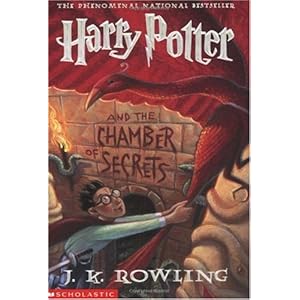
Last year, my husband and I signed up for GalleySmith's fabulous Harry Potter reading challenge.  I was so pumped because I convinced my husband to read them with me!  While we haven't exactly been reading them together, we did listen to Harry Potter and the Chamber of Secrets on audio together.


 Nine months after signing up, we are finally getting our first book review up.  (But, to look on the bright side, we read two books!)  It is really rather sad that we are given a whole year to read them and we cram all seven into the last few months.

We're also going to skip over summaries of the books.  Really, if you don't have any idea what they are about, ask your neighbor, coworker, or any kid about age 10.

Anyway, I've never done a joint review before, so this might be a little confusing or rambling, but we did our best.  My husband, Vince, isn't a big fan of writing, so I typed up his thoughts, trying to keep as much of his wording as possible.  He wanted me to note that he hasn't ever really "reviewed" books before, but I think he did just fine.  We didn't separate each book into separate thoughts and we didn't really have concrete things we liked and didn't like, so I scrapped that format for this review.  So, let's just jump right in!
Harry Potter and the Sorcerer's Stone: 10th Anniversary Edition (Harry Potter)

Vince: Rowling was really good at setting up a real-life type situation, even though you know it's not real. She has the world we live in and another world that is completely different, but hidden in our world. You almost want to believe that it's real, because being a muggle, we wouldn't know about it, right?

Me: She's created this blend of fantasy and realism that is so developed and believable. You honestly start to not be astonished when a new crazy magical creature or something is introduced, because that is just how it happens in this world. She's really got an imagination!

V: Her characters, especially the main ones, are well-developed with distinct personalities. Ron provides the humorous side of a story that in general is serious. As the story progressively gets darker, you get characters like Ron and his older brothers who provide comic relief, which is one of my favorite things about the characters.

M: I really love the humor too! I think much of the appeal of the stories are the characters. Each one, even some of the very minor characters, have quirky and unique personalities. I also love how the names she gives them that fit just right - Hagrid, Weasley, Lockhart, Quirrel, Snape. She manages to create these real characters and then she puts them in her world doing totally odd things. It makes for so many funny situations! I also like that her characters are definitely not perfect: we like Harry, but sometimes he's stupid and arrogant; we like Ron but he's dense and sometimes stubborn; we (sometimes) like Hermione but she really is annoying and a know-it-all. We like them because they are like us - flawed.

V: I like how Rowling sets up things for future books in the series, she establishes things that will be important later so they aren't randomly and suddenly introduced right when she needs them. For example, she introduces in passing the vanishing cabinet, that we know plays an important part in book six. Also, she mentions early in the series (book 2) the idea that Voldemorte put a part of himself into Harry, which is central to the story, especially in book seven.

M: She really is a queen of setting things up for later. Most of these things are just little hints throughout, stuff you totally don't notice the first time through (at least I didn't). You can see, when looking at the whole series, how much plotting she did and how carefully she crafted each book to build on the previous ones. I was particularly struck, while listening to book two, that it really was a key book in the series, setting up way in advance how Voldemorte was "immortal" and how Harry could defeat him. I think another part of the books' appeal are the complex and interwoven stories. She's got so many things going on at once, but they are all usually essential parts, even if we don't recognize them as such when we first see them. I think it takes great talent to plan all these plots and pieces out and weave them into one another.

V agreeing, but not commenting :)

M: In particular I noticed on this reading (and listening) that her descriptions are very vivid. She uses metaphors to create clear images of characters and many of them are quite humorous. I also noticed that she tends to set us up to think that one character is the cause of all the trouble, and there is a surprising and totally unexpected twist at the end. On my first reading, I never picked up on the hints throughout the story until it was revealed: not Snape, but Quirrel; not Malfoy or Hagrid, but Ginny. And I always fell for it.

Also, I think that after that first reading, it is hard to enjoy the series quite like the first time. I couldn't quite feel the same wonder and excitement. I can see some rereading of the series is inevitable, but it is definitely not quite like that first time.

V: This is my favorite series and I am loving rereading them (and watching the films).

M: Whereas I must admit I don't particularly like the films. Once is enough for me :)

Read-alikes:
If you like Harry Potter (and I haven't met many that don't) try the Ranger's Apprentice series by John Flanagan, the Artemis Fowl books by Eoin Colfer, and the Farworld series by J. Scott Savage

BOOK CONTENT RATINGS:
s-factor: !
a few

mrg-factor: none

v-factor: ->->
always some action at the end

Overall rating: **** & *****

Any thoughts you have on rereading Harry Potter?

If you buy through my Amazon linkage, I will get a very small percentage
 
Free Flash TemplatesRiad In FezFree joomla templatesAgence Web MarocMusic Videos OnlineFree Website templateswww.seodesign.usFree Wordpress Themeswww.freethemes4all.comFree Blog TemplatesLast NewsFree CMS TemplatesFree CSS TemplatesSoccer Videos OnlineFree Wordpress ThemesFree CSS Templates Dreamweaver